NMMC Doctors First in Mississippi to Repair Leaky Tricuspid Heart Valve with Innovative Device
The minimally invasive procedure offers new hope for patients unable to undergo open heart surgery.
NMMC Doctors First in Mississippi to Repair Leaky Tricuspid Heart Valve with Innovative Device
The minimally invasive procedure offers new hope for patients unable to undergo open heart surgery.TUPELO, Mississippi—Heart doctors at North Mississippi Medical Center have become the first in Mississippi to repair a leaky tricuspid valve using a first-of-its-kind device designed specifically for complex cases.
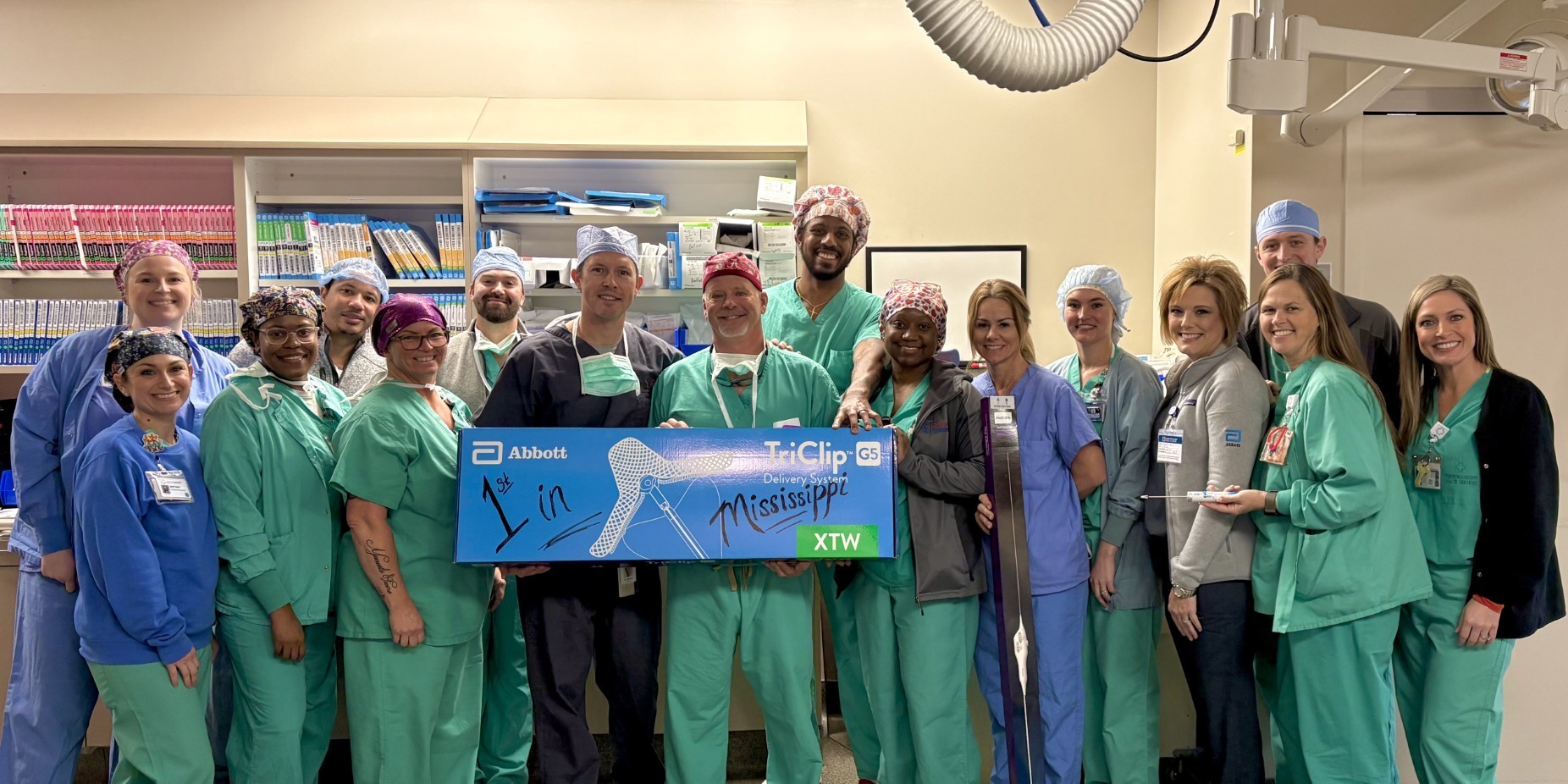
On Feb. 19, cardiothoracic surgeon Dr. David Talton and interventional cardiologist Dr. Dane Ballard successfully implanted Abbott’s TriClip™ G5 transcatheter edge-to-edge repair (TEER) system to treat tricuspid regurgitation in select patients who aren’t candidates for open-heart surgery.
“In tricuspid valve regurgitation, the valve between the two right heart chambers (the right ventricle and right atrium) doesn’t close properly, allowing blood to flow backward into the heart,” Dr. Ballard explains. “It can be debilitating for people, causing shortness of breath and fatigue. Without treatment, it can progress into atrial fibrillation, heart failure and, ultimately, death.”
The tricuspid valve is often referred to as the “forgotten valve” because of its limited treatment options. Traditionally, doctors have relied on medication, which is rarely effective, and surgery, which is seldom performed because of the complexity of the procedure and the high risks involved.
The minimally invasive approach provides a new option for a condition that has historically been hard to manage. “In this procedure, we guide the device to the heart via a catheter inserted through the femoral vein in the patient’s leg,” Dr. Talton says. “The device clips together a portion of the valve’s leaflets, reducing the backflow of blood and allowing the heart to pump more efficiently."

Contact Us
Have a question, or would you like to learn more? Please contact us at The Desk (1-800-843-3375)
Topics
- Heart & Vascular